
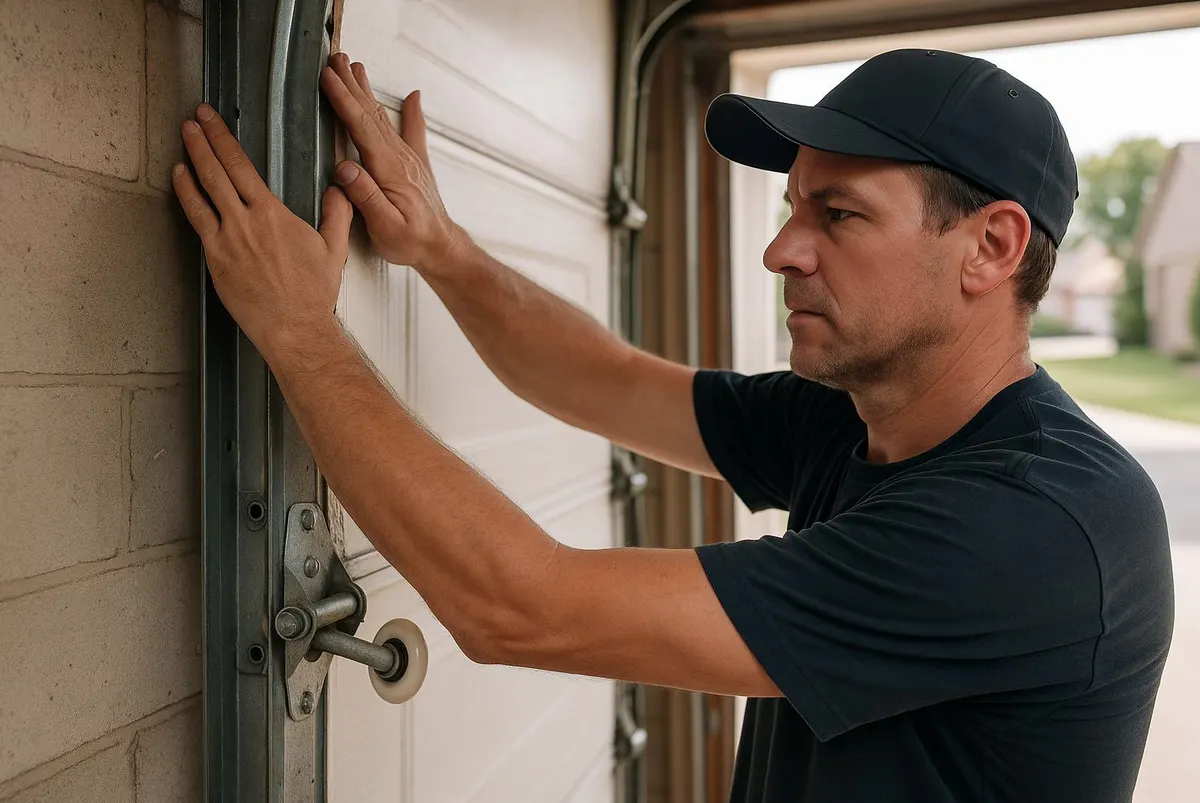
Rule of thumb: if your garage door won't open, it's almost always power or springs, not the opener itself. The exceptions are a locked-out opener motor after a storm, a manual release cord that got bumped loose, or a track that's swollen or bent from humidity and summer downpours. Knowing which one you're dealing with starts with paying attention to exactly how the door is failing.
What "Won't Open" Actually Looks Like
Not every "won't open" problem presents the same way, and the symptom usually points straight to the cause before you even touch a tool.
- Total silence — you press the remote or wall button and absolutely nothing happens, no light, no hum.
- The motor runs but the door doesn't move — you hear the opener working, maybe see the chain or belt moving, but the door stays put.
- The door creeps up a few inches then stops or reverses — it's trying, but something is fighting it.
- The door is heavy, slow, or crooked as it lifts — one side rises faster than the other, or it strains the whole way.
- Remote doesn't work but the wall button does, or vice versa — points to the opener's electronics rather than the door's mechanical parts.
Hold onto that description, because it's the fastest way to skip straight to the right cause below instead of guessing.
The Order a Technician Checks Things
1. Power to the Opener
This sounds obvious, but it's the most common reason for total silence, especially after one of our afternoon thunderstorms knocks out power or trips a breaker. Check that the opener is plugged in, check the breaker or GFCI outlet it runs on, and if your opener has a battery backup, check whether that battery has died — backup batteries typically last 2-3 years and often fail quietly until a power blip exposes them.
2. The Manual Release Cord
Every opener has a red cord that disconnects the door from the trolley so it can be opened by hand during a power outage. If that cord got pulled — by a curious kid, a stored item brushing against it, or someone preparing for a storm and forgetting to reset it — the opener will run, sound normal, and the door simply won't lift. Reconnecting it is usually as simple as pulling the cord again or pushing the trolley back into the carriage until it clicks.
3. The Springs
If the opener motor is straining, humming, or the door only lifts a few inches before stopping, a broken or weakened spring is the likely culprit. Garage door springs carry almost the full weight of the door — the opener is only meant to guide it, not lift dead weight. In this area, springs also take a beating from humidity and heat cycling through the day, which shortens their working life compared to drier climates. A broken spring often shows up as a visible gap in the coil above the door, or a loud bang you heard earlier in the day that you brushed off. This is not a DIY repair — torsion springs are under enough tension to cause serious injury, and it's one of the most common calls we get.
4. The Cables and Drums
If one side of the door looks crooked or hangs lower than the other, a cable has likely slipped off its drum or snapped. This often happens alongside spring failure, since the cables and springs work together to balance the door's weight. A loose or frayed cable is a safety hazard and needs replacing, not just rehanging.
5. The Track and Rollers
Tracks can bend from an impact, or the rollers can bind from rust and swelling after a rainy stretch — moisture gets into steel rollers and tracks faster here than in drier parts of the country. If the door jumps, grinds, or stops partway with a visible gap between the roller and track, this is the likely cause. Minor misalignment can sometimes be adjusted, but a bent track usually needs to be reshaped or replaced before the door will move smoothly again.
6. The Opener's Gear and Motor
Last on the list, because it's the least common failure point: the opener's internal drive gear (often plastic by design, so it fails before the motor burns out) or the motor itself can wear out. You'll know it's this if the opener hums with no movement at all, even after confirming power, the release cord, springs, cables, and track are all fine. Gear replacement is often cheaper than a full opener swap, but if the unit is older, sometimes replacing it outright makes more sense than repeatedly patching an aging motor.
When to Call Clermont Garage Door Service
If you've checked the power and the release cord and the door still won't budge, stop there and call us rather than continuing down the list yourself — springs and cables under tension aren't a safe DIY project, and a bent track can get worse if the door is forced. We handle Garage Door Spring Repair and Off Track Door Repair as same-type calls almost every week across Clermont, Minneola, and the rest of South Lake County, and we'll diagnose which of the six causes above is actually behind your stuck door before quoting any work.
If your garage door in Clermont, FL won't open, give Clermont Garage Door Service a call — we'll get it diagnosed and moving again, usually the same day.